FAIR principles and user feedback on the SSH Open Marketplace

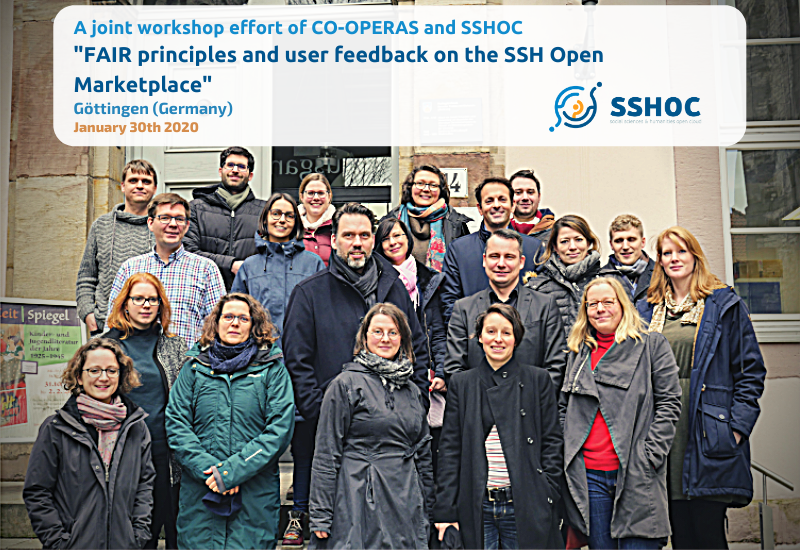
CO-OPERAS and SSHOC share a similar task: supporting researchers in the social sciences and humanities to integrate their work and results according to the FAIR principles. To this end, SSHOC and CO-OPERAS organised a joint workshop revolving around FAIR principles for research data in the SSH on the one hand and the development of the SSH Open Marketplace on the other.

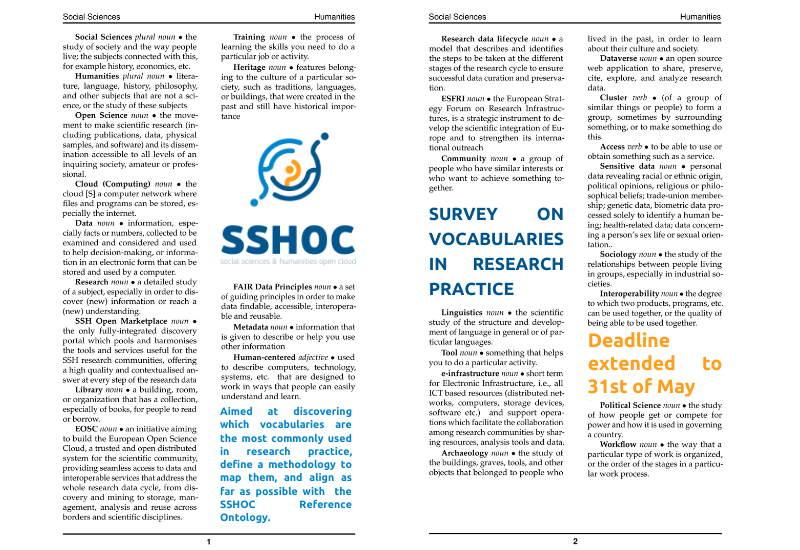
Vocabularies in SSH research practice: SSHOC launches a survey to discover and map them

SSHOC is organising a survey, reaching out to all researchers in the Social Sciences and Humanities (SSH), to discover which vocabularies are the most commonly used in SSH research practices, define a methodology to map them, and align as far as possible with the SSHOC Reference Ontology.

This research will result in an interesting and detailed analysis, to be released on December 31st 2020.

SSHOC: Boosting User Reach and Relevance

A new report from the SSHOC consortium highlights important roles for the SSH community in engaging potential users of the products and services being developed within the project. 
Entitled “Challenges user communities face when attempting to contribute to SSHOC”, the report analyses and describes the key obstacles to discovery and productive use of the SSH resources - which will also be incorporated into the European Open Science Cloud (EOSC). Amongst the remedies given prominence in the report are awareness creation, training, and the implementation of standards.
SSHOC 2019 Overview

A comprehensive A-Z review of the key events, publications and milestones that marked our progress during the first year of the SSHOC project.

EOSC, ESFRI Cluster Projects, RDA: Connecting commonalities and collaborative solutions for community research data services

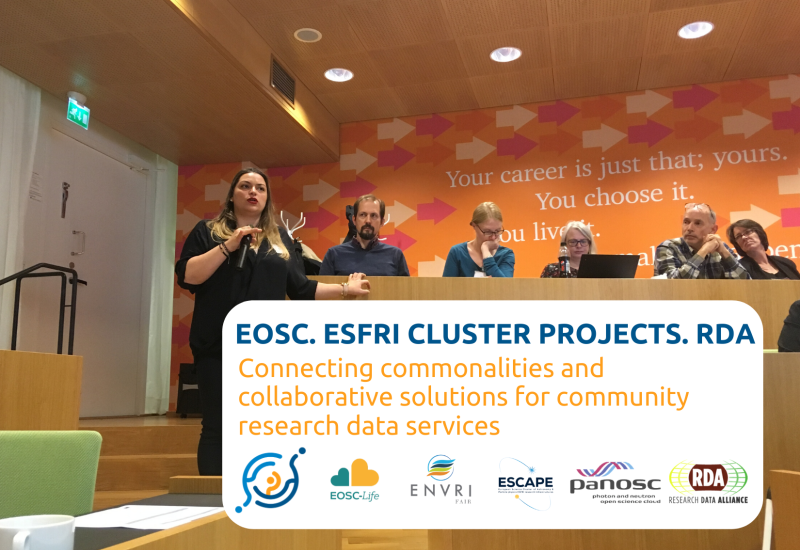
On 21 October, during the Research Data Alliance Plenary Meeting in Helsinki, SSHOC invited representatives from EOSC, the ESFRI cluster projects, and the RDA Working and Interest Groups, to discuss mutual commonalities and opportunities for collaboration.  A cross-section of some 40 individuals attended the 4 hour workshop which was introduced by SSHOC Coordinator and EOSC Executive Board member Ron Dekker of CESSDA. The report on the proceedings from the meeting in Helsinki is out now.  

Using corpora for implementing validation: SSHOC masterclass on workflows that combine quantity and quality

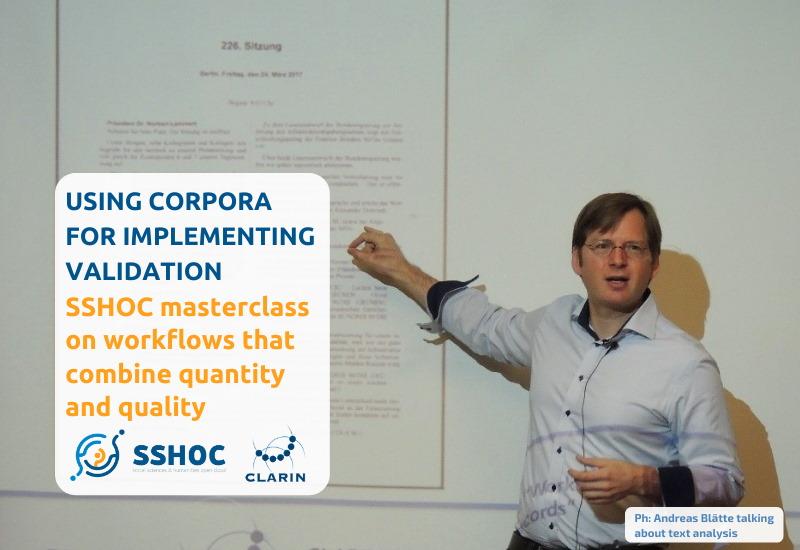
At the CLARIN Annual Conference 2019 in Leipzig, SSHOC partners organised a masterclass for political and social scientists with an interest in using large text collections in their research. This event contributed to two major SSHOC objectives: developing relevant and applicable tools for specific user communities and empowering those communities to actively use such tools. The masterclass addressed the challenges that political and social scientists encounter when confronted with the need to validate their findings obtained with quantitative analysis of text corpora.