One research group of particular interest to SSHOC is a data community undertaking research on ethnic and migration studies.

Led by Prof Laura Morales (Sciences Po) with support from Ami Saji and a small team of junior researchers and research assistants, a SSHOC task group is working to improve how quantitative survey data on ethnic and migrant minorities (EMMs) can be shared with and discovered by a wide range of users in Europe and beyond.

This task group is working hand in hand with two closely related projects, COST Action 16111 – ETHMIGSURVEYDATA, (a research network with 200 plus members who are primarily based in Europe, and are part of the ethnic and migration studies field) and FAIRETHMIGQUANT, (a project funded via the French Agence Nationale de la Recherche Open Science call). 

Making Quantitative EMM Surveys FAIR

During the course of the SSHOC project, this task group, in collaboration with ETHMIGSURVEYDATA and FAIRETHMIGQUANT, will:

  1. Produce and launch the EMM Survey Registry, a free online tool that has been shaped according to the FAIR (Findable, Accessible, Interoperable, Reusable) principles and set up to display compiled survey-level metadata for over 800 quantitative surveys that include samples of EMM (sub) populations from over 30 different countries.

  2. Test the feasibility of setting up, as part of the CESSDA-led European Question Bank (EQB), a collection dedicated to surveys targeting EMM respondents that have been previously identified via the development of the EMM Survey Registry.

Currently, the EMM Survey Registry is available in Beta version and displays information gathered for over 760 surveys from 18 different European countries.  Testing of an EMM-dedicated collection of the EQB is also underway.

Further Reading

Associated report: Database with the metadata of surveys to EMMs across Europe

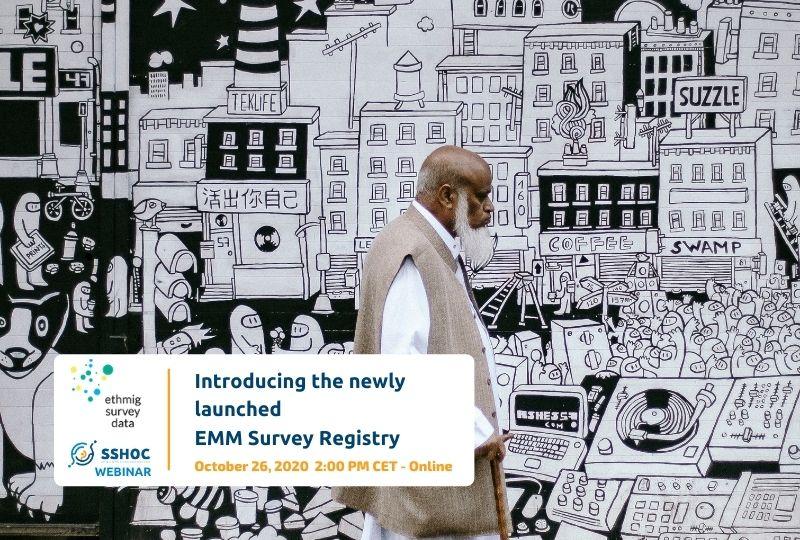
Associated webinar: Introducing the newly launched Ethnic and Migrant Minorities (EMM) Survey Registry

Post webinar report: WEBINAR NOTES: Introducing the newly launched EMM Survey Registry


Have a question? Direct it to us on: sshoc.project@sciencespo.fr

SSHOCingly good and sustainable tools

This report is a shortened version that contains the second part of the SSHOC legacy booklet, showcasing the tools, resources and plug & play communities produced by the SSHOC project, through their dedicated factsheets. We start this section with the SSH Open Marketplace, and continue with the factsheets per category: Sharing & Discovery, Data Management, Processing & Analysis, Datasets, Training & Support
SSHOC Legacy booklet

The social sciences and humanities (SSH) encompasses researchers with roots in very diverse domains and methodological frameworks, from heritage researchers documenting work with 3D digital objects to interdisciplinary social researchers seeking new modes to analyse existing sources, to name but a few. In the digital age, new insights and ground-breaking research increasingly relies on powerful, tailored tools and environments for research within and across disciplines.

SSHOC Exploitation Plan

This Exploitation Plan gives an overview of the joint and multiple individual exploitation paths aimed at increasing the impact of all the Key Exploitable Results developed during the SSHOC project lifetime (from January 2019 to April 2022). The Plan is aligned with the contractual obligations defined in articles 28 and 29 of the SSHOC Grant Agreement (No. 823782).

D9.5 Feasibility report on setting up a collection on questionnaires relating to Ethnic and Migrant Minorities in the European Question Bank

This document is a deliverable of the Social Sciences and Humanities Open Cloud (SSHOC) project. It is a report assessing the feasibility of setting up, as part of the CESSDA ERIC-led European Question Bank (EQB), a collection dedicated to the questionnaires and question items included in quantitative surveys on Ethnic and Migrant Minorities’ (EMMs’) inclusion and/or integration identified as part of the creation of the EMM Survey Registry (i.e. the SSHOC Deliverable 9.4 Database with the metadata of surveys to EMMs across Europe1).

D9.11 Concluding Report on T9.3

This report recapitulates the work done in SSHOC Task T9.3, the Data Community Project for Electoral Studies. Its purpose was to develop a pilot of a Knowledge Graph (KG) in the field of Electoral Studies. The first sections of the report recapitulate the background of and motivation for this purpose, and the manner in which the pilot-KG was developed. Section 4 discusses a number of overarching insights that derive from the work done and the experiences that were gained in the process.

D9.2 Midterm evaluation report

Three of the Tasks in WP9 (Data Communities) are associated with particular user communities. These are Ethnic and Migration Studies (associated with T9.2), Electoral Studies (associated with T9.3), and Heritage Science (associated with T9.4). Each of these three tasks has as a major part of its remit the production of services, tools, procedures and data of direct relevance for their respective user communities.

CESSDA Roadshow on Migration

08 October 2021

Location: Online

With approximately 281 million people, or 3.6 % of the world’s population, currently living outside their country of birth, migration policies need to be based on reliable and impartial evidence. As the leading Consortium of European Social Science Data Archives, CESSDA™ offers a wealth of resources for researchers, enabling them to use and re-use datasets and define their data management plan.

The Ethnic and Migrant Minorities (EMM) Survey Registry, a free online database and tool that displays detailed information about existing quantitative surveys conducted with EMM populations in Europe. 

Type: Dataset
Property: Sharing & discovery
Accessible at: EMM Survey Registry

D9.4 Database with the metadata of surveys to EMMs across Europe

This report describes the Ethnic and Migrant Minorities (EMM) Survey Registry, an online, publicly available database and tool that displays compiled, survey-level metadata of existing quantitative surveys undertaken with ethnic and migrant minority (EMM) populations in Europe.