SSHOC Legacy booklet

The social sciences and humanities (SSH) encompasses researchers with roots in very diverse domains and methodological frameworks, from heritage researchers documenting work with 3D digital objects to interdisciplinary social researchers seeking new modes to analyse existing sources, to name but a few. In the digital age, new insights and ground-breaking research increasingly relies on powerful, tailored tools and environments for research within and across disciplines.
SSHOC Exploitation Plan

This Exploitation Plan gives an overview of the joint and multiple individual exploitation paths aimed at increasing the impact of all the Key Exploitable Results developed during the SSHOC project lifetime (from January 2019 to April 2022). The Plan is aligned with the contractual obligations defined in articles 28 and 29 of the SSHOC Grant Agreement (No. 823782).

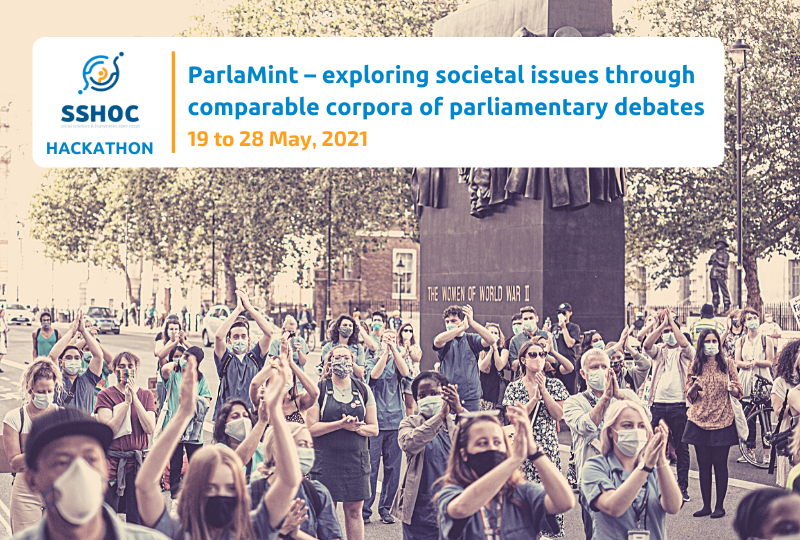
SSHOC workshop: Par­laMint – exploring societal issues through com­par­able cor­pora of par­lia­ment­ary de­bates

19 May 2021 to 28 May 2021

Location: Online at Helsinki Digital Humanities Hackathon #DHH21

In this workshop, the group of researchers will focus on the comparison of parliamentary debates before and during Covid pandemic across Europe from a linguistic, sociological, politological and/or computational perspective. The group’s objective will be to learn how to use comparable parliamentary corpora from various European countries that are annotated with metadata, such as speaker and session information, and linguistic annotations, such as morphosyntactic and named entity tags, for studying societal issues caused by the Covid-19 pandemic.

SSHOC Workshop: Using Corpora for Implementing Validation. Workflows that combine quantity and quality

30 September 2019

Location: Leipzig, Germany

Lowering the costs of integrating quantitative and qualitative steps in workflows using corpora in social science research designs is a major objective of Research Infrastructures such as CLARIN, and of the polmineR package, an open source R package available at the Comprehensive R Archive Network / CRAN.

This workshop addresses the challenges that specific user communities experience when contributing to SSHOC, the availability of procedures, tools and services to address these challenges, and the extent that these procedures, tools and services are sufficiently applicable for specific user communities, which is one of the major goals of the SSHOC project, tackled within WP9.