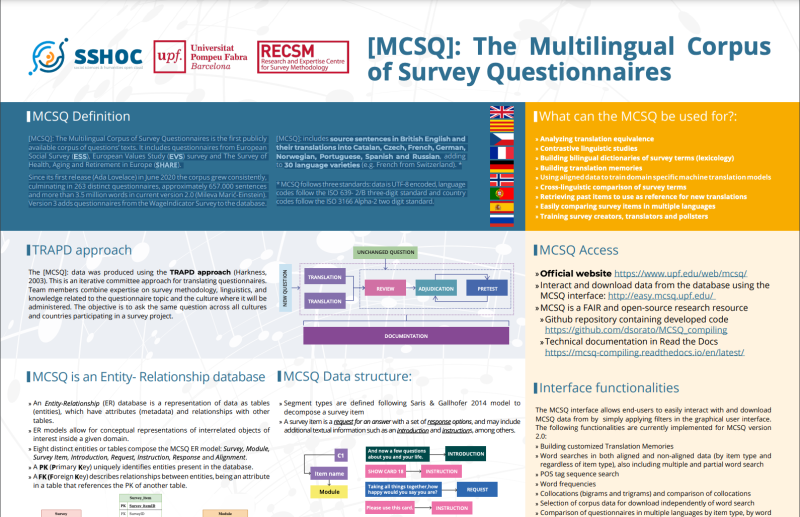
The compilation of the [MCSQ]: Multilingual Corpus of Survey Questionnaires

09 July 2021

Location: Online


Work Package 4 team working on the preparation of the tools for the use of Computer Assisted Translation (UPF, UVT-EVS, CentERdata, CLARIN/CUNI) is presenting a poster as a part of a session about innovative methods for different stages of multinational survey research - from invitations to participate, to the design and translation of questionnaires, to the analysis of survey results at the European Survey Research Association (ESRA) conference 2021.


The ESFRI Clusters at RDA House of Commons

Debating commonalities and collaboration for thematic services, training and governance towards the European Open Science Cloud

One and a half years after the RDA session in Helsinki, the five ESFRI cluster projects, the RDA community, and European Open Science Cloud (EOSC) representatives come together again, to discuss the past, present and future of their collaboration during the journey of integrating thematic services into EOSC.
LIBER2021

23 June 2021 to 25 June 2021

Location: Online

LIBER’s Annual Conference is a key meeting point for research library professionals.

Held in late June or early July, the conference brings library directors and their staff together for three days of networking and collaboration. Delegates mainly come from Europe but people from around the world are welcome, and we regularly welcome guests from countries including Australia, Canada and the United States.

SSHOC communities fighting COVID-19

01 June 2021 to 03 June 2021

From 1st to 3rd June SSHOC is participating in ICRI virtual international conference giving a detailed overview of how SSHOC communities are contributing to the fight against COVID-19.

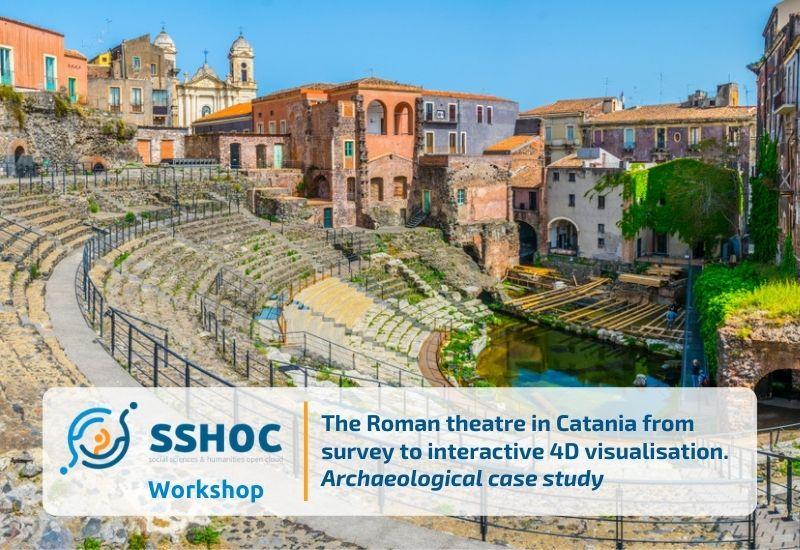
SSHOC archaeological case study Workshop - The Roman theatre in Catania from survey to interactive 4D visualisation

25 May 2021

Location: Online

Archaeological field work is a complex process in which scientific resources and competences are allocated for long periods of time, sometimes years. However, the generated data is often either not available in digital form, stuck in data silos or not public. For this reason, the sustainability of archaeological research would benefit immensely from optimized and effective systems of digital documentation, analysis and visualisation of archaeological sites as well as from public, standardised data.