


SSHOC workshop: SSH Code of Conduct

17 March 2021

Location: Online

The SSHOC project announces an interactive workshop aimed at practitioners and policy makers involved in the work on GDPR, research ethics, and Code of Conducts. 
Participants will gain insights on experiences about codes of conducts, offering the opportunity to discuss the need for code of conducts, and possible challenges and experiences regarding establishments of code of conducts. 

SSHOC workshop: SSH Code of Conduct

17 March 2021

Location: Online

The SSHOC project announces an interactive workshop for policy makers, practitioners and others working with GDPR, research ethics, and Codes of Conduct. 

Participants will gain practical insights into the challenges inherent in establishing a Code of Conduct and learn the how and why from experts in the field.

The outcomes of the workshop will be incorporated into an ongoing project task to set up a Code of Conduct specifically for Social Sciences and Humanities researchers. 

Train-the-Trainer RDM Bootcamp

08 February 2021 to 11 February 2021

Location: Online

SSHOC and DARIAH-ERIC announce an interactive Research Data Management bootcamp for trainers, data supporters, librarians and data stewards in the humanities and social sciences. 

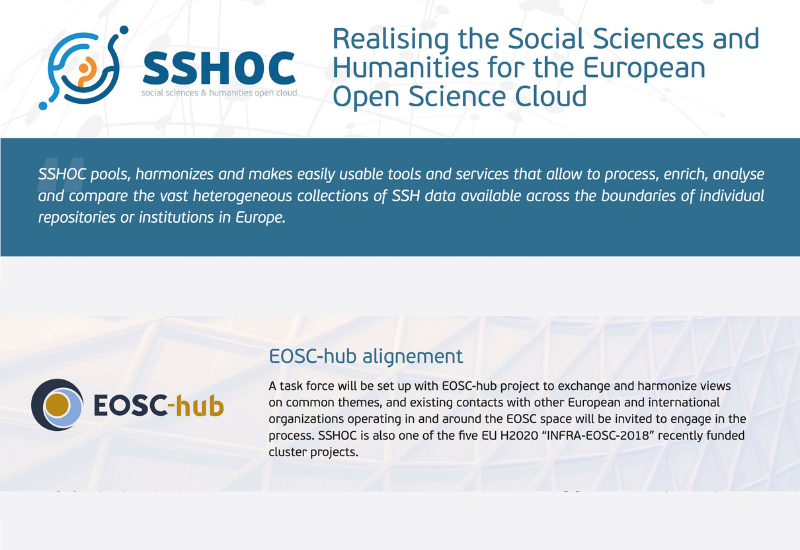
Realising the Social Sciences and Humanities for the European Open Science Cloud - EOSC Hub

The Social Sciences and Humanities Open Science Cloud (SSHOC) is one of the five European Union H2020 Programme “ INFRA-EOSC-2018” recently funded cluster projects (together with ENVRI-FAIR, PANOSC, ESCAPE, EOSC-LIFE) that will leverage and interconnect existing and new infrastructures from the SSH ERICs and foster interdisciplinary research and collaboration. A task force will be set up with EOSC-hub project to exchange and harmonize views on common themes, and existing contacts with other European and international organizations operating in and around the EOSC space will be invited to engage in the process.
First Train-the-Trainer Bootcamp

02 June 2020

Location: Online

On 2 June 2020, the SSHOC training team will unveli the SSHOC Training Toolkit at their first ever Train-the-Trainer Bootcamp!

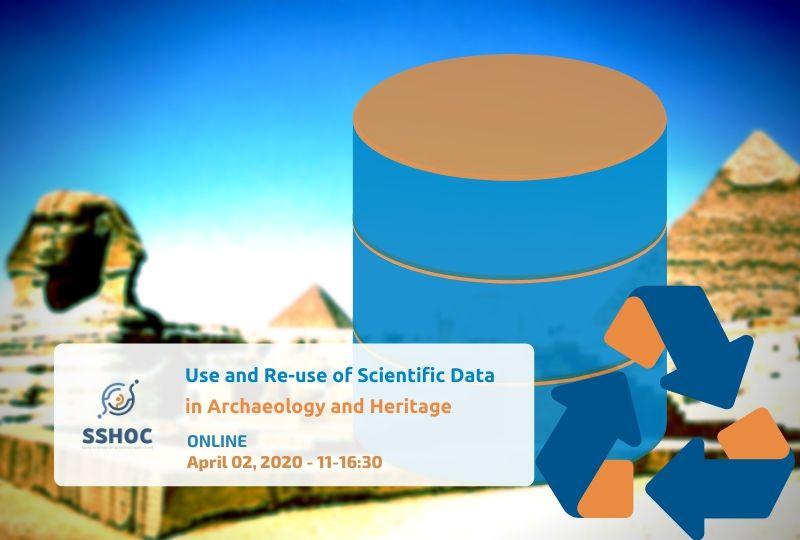
Use and Re-use of Scientific Data in Archaeology and Heritage

02 April 2020

Location: Online

An opportunity to learn about novel policy and best practice around use and re-use of scientific data within the heritage science and archaeology contexts in this half-day webinar jointly organised by SSHOC, SEADDA and E-RIHS. Running live on Thursday 2nd April, from 12.00 to 16:30 CEST, we will present the new heritage science data curation policy developed by E-RIHS and SEADDA, discuss practice challenges and share best tools to support on data re-use. 

D6.7 Inventory of existing learning materials

This report gives an overview of the landscape of training material in the SSH disciplines cluster and the broader context of EOSC based on inspecting main existing sources of training materials and their content. The collected information serves as input for further activities in WP6 as well as an important source of information for WP7.

SSHOC Webinar: CLARIN Hands-on Tutorial on Transcribing Interview Data

03 March 2020

Location: Online

In this first of a series of SSHOC webinars we will discuss the theoretical basis and the technology available for transcribing spoken language. In particular, we will focus on the role of automatic speech recognition – what are the opportunities, what are the pitfalls and to where can it be applied successfully.

SSHOC Workshop: Using Corpora for Implementing Validation. Workflows that combine quantity and quality

30 September 2019

Location: Leipzig, Germany

Lowering the costs of integrating quantitative and qualitative steps in workflows using corpora in social science research designs is a major objective of Research Infrastructures such as CLARIN, and of the polmineR package, an open source R package available at the Comprehensive R Archive Network / CRAN.

This workshop addresses the challenges that specific user communities experience when contributing to SSHOC, the availability of procedures, tools and services to address these challenges, and the extent that these procedures, tools and services are sufficiently applicable for specific user communities, which is one of the major goals of the SSHOC project, tackled within WP9.